

Outsourced CAD Services can help construction companies add drafting capacity without immediately taking on another full-time local employee. But that doesn’t mean outsourcing is always the better option.
For some companies, an in-house CAD team makes perfect sense. They’ve got a steady project pipeline, enough work to keep their drafters busy, and a strong reason to have everyone working together locally.
For others, the situation is different.
They may have more projects than their current team can handle. They may be struggling to find qualified Civil 3D Drafters locally. Or they may simply need additional drafting support without expanding their office.
That’s where outsourced CAD services, CAD staff augmentation, and dedicated remote CAD drafters come into the picture.
If you’re a construction company owner, operations manager, engineering manager, or project manager, the decision shouldn’t come down to cost alone. You also need to think about workload, quality, management, hiring, communication, and how quickly you need additional capacity.
So, which approach makes the most sense for your company?
Let’s take a closer look.
What Are Outsourced CAD Services?
Outsourced CAD services involve hiring an outside provider to handle some or all of your CAD drafting work.
The arrangement can look very different from one provider to another.
You might send a specific project to a CAD company and receive the completed drawings. You could hire a freelancer for occasional work. Or you might work with a staffing provider that gives you a dedicated CAD professional who works with your team on an ongoing basis.
The type of work can vary, too.
Depending on your requirements, an outsourced CAD professional may handle:
- Construction drawings
- Site plans
- Grading plans
- Utility layouts
- As-built drawings
- Redline updates
- Drawing revisions
- CAD documentation
- Civil 3D drafting
- Drawing cleanup
- Production drafting
This is why the word “outsourcing” can sometimes be misleading.
Two companies might both offer outsourced CAD services while providing completely different arrangements.
One might simply complete projects for you. Another might provide a dedicated Civil CAD Drafter who works with your team every day.
That difference matters.
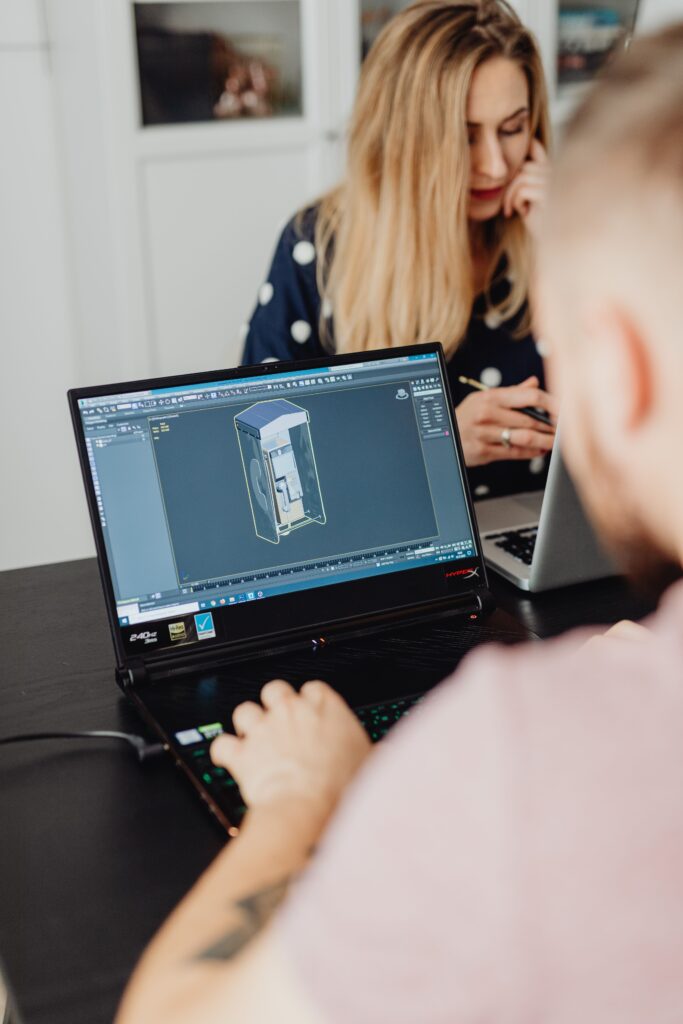
In-House CAD Teams vs. Outsourced CAD Services
The in-house model is straightforward.
You find a CAD professional, hire them, put them on your payroll, provide their equipment and software, and manage their work directly.
There are some clear advantages.
Your drafter can work closely with engineers and project managers. They can ask questions quickly. They can sit in project meetings and get familiar with how your company operates.
Over time, they can also build valuable knowledge about your clients, templates, drawing standards, and typical projects.
But there’s another side to the equation.
You’re responsible for finding that person, hiring them, paying their salary and benefits, providing equipment, handling HR matters, and keeping them productive.
That’s a lot to take on for one additional employee.
Outsourced CAD services can shift some of those responsibilities to an external provider.
That can be useful when you need more drafting capacity but don’t necessarily want to build another local position from scratch.
The Real Cost of Hiring an In-House Civil CAD Drafter
When construction companies compare an in-house hire with outsourced CAD services, salary is usually the first number they look at.
It shouldn’t be the only one.
An in-house Civil CAD Drafter can also mean:
- Recruitment costs
- Payroll and benefits
- Computer hardware
- CAD software
- Office space
- IT support
- Training
- HR administration
- Paid leave
- Employee turnover
Then there’s management time.
Someone has to write the job description. Someone has to interview candidates. Someone has to train the new employee and get them familiar with your systems.
And if that person leaves six months later?
You start the process again.
This doesn’t mean hiring locally is a bad idea. Far from it.
For a company with a consistent workload, an in-house employee can be an excellent investment.
The question is whether you need another permanent local employee or whether you simply need more drafting capacity right now.
When Does an In-House CAD Team Make Sense?
An in-house team can be the right choice when CAD work is a major and consistent part of your business.
Imagine a civil construction company with a steady pipeline of projects. Its drafters are busy most weeks, engineers work closely with them, and the company expects that workload to continue for years.
In that situation, hiring another full-time employee could make perfect sense.
There are also situations where having people physically close to the rest of the team is important.
Some projects require constant collaboration with engineers, field teams, and clients. Others involve company-specific processes that take considerable time to learn.
An experienced internal employee can become extremely valuable in those situations.
There’s also the issue of institutional knowledge.
A drafter who’s been with your company for five years might know exactly how your team likes its drawings prepared. They may know your templates, common client requirements, and even the mistakes that tend to cause problems.
You can’t put all of that knowledge into a job description.
But an in-house team isn’t always necessary.
Sometimes, the problem is much simpler.
You’ve got too much work and not enough people.
When Do Outsourced CAD Services Make More Sense?
Outsourcing becomes more attractive when your workload has grown faster than your team.
Here are a few situations where it could make sense.
1.You’ve just won several new projects
This is a good problem to have.
But it can still create a headache.
Your engineers are busy. Your existing drafters are booked. Deadlines are getting closer.
Hiring locally could take weeks or months.
Outsourced CAD services can give you additional capacity while your internal team keeps working.
2.Your engineers are spending too much time drafting
Your engineers have plenty on their plates.
They’ve got designs to review, clients to deal with, site issues to solve, and project decisions to make.
If they’re also spending hours making routine drawing changes, updating plans, or handling production drafting, your team may not be using its time efficiently.
A dedicated CAD professional can take care of much of that work.
Your engineers can then focus on the responsibilities that require their experience.
3.You can’t find the right person locally
Sometimes, you’re ready to hire.
The candidates just aren’t there.
This can be especially difficult when you need a Civil 3D Drafter with specific experience.
Expanding your search beyond your local market can give you access to a much larger talent pool.
4.Your workload goes up and down
Construction doesn’t always follow a predictable schedule.
You might have several large projects this year and a much lighter pipeline next year.
Hiring a permanent employee during a temporary spike in demand can leave you with more capacity than you need later.
Outsourcing can give you another option.
5.You’re trying to grow without expanding your local office
A new employee isn’t just another salary.
You may also need another computer, software license, desk, office space, IT support, and HR resources.
For companies trying to grow carefully, a dedicated offshore employee can be an attractive alternative.

What Is CAD Resource Augmentation?
CAD resource augmentation means adding another professional to your team when your existing staff doesn’t have enough capacity.
It’s different from handing an entire project to an outside company.
Let’s say you’ve got five engineers and two drafters.
Then you win several new projects.
The engineers know what needs to be done. Your project managers know how they want the work handled. Your existing drafters understand your standards.
The problem?
There simply aren’t enough hours in the day.
A CAD resource can fill that gap.
The additional professional can handle drafting and documentation while your existing team continues managing the engineering and project work.
It’s a simple idea.
You need more people, so you add another resource.
CAD Staff Augmentation vs. Traditional CAD Outsourcing
These terms are often used interchangeably. They shouldn’t always be.
With traditional project-based outsourcing, the relationship might work from your company to the CAD Provider, and finally toward completed designs.
In this scenario, you give the provider a scope of work. They complete it and deliver the agreed-upon files.
That’s useful for defined projects.
Staff augmentation works differently. In that scenario, your company is directly connected to a dedicated CAD professional and linked directly with your existing team.
Thus, the CAD professional becomes an extension of your team.
Your project manager can assign work directly. Your engineers can provide feedback. Your team can review drawings and request changes as the project develops.
That ongoing relationship can be particularly useful when you have CAD work every week rather than one large project every few months.
Over time, that familiarity creates efficiency.
You’re no longer explaining your process from scratch every time a new project arrives.
This is also where dedicated staffing can differ significantly from hiring freelancers for individual assignments. A dedicated professional can become an extension of your existing team rather than simply completing isolated tasks.
What About Civil 3D Outsourcing?
For civil construction companies, CAD outsourcing often means something more specific.
You don’t just need someone who understands basic CAD. You may need someone who knows Civil 3D and has experience with the types of drawings your company produces.
That’s where Civil 3D outsourcing can be useful.
Autodesk Civil 3D is built for civil infrastructure work and supports workflows involving surfaces, grading, corridors, pipe networks, and other civil design tasks.
So if you’re looking for AutoCAD Civil 3D Services, you need to pay attention to the person’s actual experience.
A general CAD drafter isn’t automatically a good Civil 3D Drafter.
Software knowledge matters.
Project experience matters, too.
Real-World Example: Seven Spikes Road Contracting
There’s a useful example from Autodesk involving Seven Spikes Road Contracting LLC.
The company moved from primarily 2D CAD workflows toward Autodesk Civil 3D. According to Autodesk’s case study, changes made within its Civil 3D model could update connected elements automatically. This reduced some of the manual work involved in its previous 2D process.
The company also found that Civil 3D supported collaboration across engineering disciplines.
You can read Autodesk’s Seven Spikes Road Contracting case study.
The lesson isn’t simply that every construction company should move to Civil 3D.
It’s that the right tools can change how much work a drafting team can handle.
That makes the person using those tools just as important.
How Can a Remote CAD Drafter Work With Your Team?
A Remote CAD Drafter doesn’t have to feel like a separate vendor.
With the right setup, they can work much like another member of your team.
They can join meetings. They can communicate with project managers. They can follow your drawing standards and use the same project management systems.
Most importantly, they can work your hours.
That last point matters more than many companies realize.
Imagine your construction team works from 8 a.m. to 5 p.m. Your CAD drafter works completely different hours because they’re offshore.
You send a revision request at 4 p.m.
You don’t hear back until the next day.
Now a simple change has taken an extra day.
A dedicated offshore employee working the same hours as your U.S. team removes much of that delay.
This is one of the major differences between a dedicated remote employee and simply sending CAD work to an outside vendor.
A Real-World Example: Graham Construction
Graham Construction offers another useful example.
In an Autodesk case study, the company explored the use of Civil 3D by site engineering teams. The software was used for activities including setting-out data, volume calculations, and as-built information.
Autodesk reported that the approach reduced the site’s reliance on the design office for certain tasks while improving CAD skills and productivity at the site.
You can read the Graham Construction case study on Autodesk.
There’s a broader lesson here.
CAD isn’t just a back-office function.
When drafting information is produced and updated efficiently, it can have an impact on the wider construction process.
What Should Stay In-House?
Outsourcing doesn’t mean everything needs to be outsourced.
Some responsibilities should probably stay with your internal team.
Engineering decisions are one example.
Client relationships are another. So are project leadership, final design responsibility, and work that requires deep knowledge of a particular client’s expectations.
But plenty of production work can be handled by an experienced CAD professional.
That could include:
- Drawing production
- Drawing revisions
- Redline changes
- CAD cleanup
- As-built drawings
- Civil 3D modeling
- Documentation
- Repetitive drafting work
The goal isn’t to outsource everything.
It’s to decide where your internal team’s time is most valuable.
You have to Ask,
What work actually requires my engineers and project managers, and what work could be handled by a dedicated CAD professional?
That question can reveal some surprisingly simple ways to increase your team’s capacity.
How to Choose the Right CAD Staffing Model
Before making a decision, ask yourself a few practical questions.
Do we have enough CAD work for another full-time person?
If you do, a dedicated resource may be a better fit than project-by-project outsourcing.
Is our existing team overloaded?
If your drafters are consistently working late or your engineers are doing production drafting, it’s probably time to add capacity.
Are we struggling to recruit locally?
If you’ve advertised a position several times without finding the right candidate, an offshore hiring model could widen your options.
Do we need someone every day?
If the answer is yes, dedicated staff augmentation may make more sense than sending individual projects to an external provider.
Do we need Civil 3D experience?
If you do, make sure you’re hiring someone who actually has that experience.
Don’t assume that every CAD drafter can step into a Civil 3D-heavy role.
How predictable is our workload?
If your CAD requirements change dramatically from month to month, project-based outsourcing may give you more flexibility.
Where Remotation Fits In
For construction companies that need ongoing drafting capacity, there’s a big difference between outsourcing a project and hiring a dedicated offshore employee.
Remotation’s remote CAD drafter service is built around the dedicated employee model.
Instead of simply sending your drawings to a third-party company, you can hire a dedicated CAD professional who works for your business during your working hours.
Remotation handles the employment side of the arrangement, including providing the employee’s workplace and infrastructure. The professional then works according to your company’s schedule, processes, and requirements.
That gives construction companies another option.
You don’t necessarily have to choose between hiring another local employee and sending your projects to an outside CAD vendor.
You can build a dedicated offshore CAD resource that works as part of your existing team.
So, Which Option Is Right for Your Construction Company?
There’s no single answer.
An in-house CAD team can be the best choice if you’ve got a consistent workload, need close collaboration, and want to build long-term knowledge within your organization.
Traditional outsourced CAD services can work well when you’ve got specific projects or temporary increases in workload that you don’t want to handle internally.
CAD staff augmentation can make more sense when you’ve already got a good team but simply need more people to keep up with demand.
And if you need someone who can become part of your day-to-day workflow, a Remote CAD Drafter can provide a middle ground between traditional outsourcing and local hiring.
Don’t make the decision based on price alone.
Look at your project pipeline. Think about how quickly you need additional capacity. Consider the skills you’re missing and how much management you want to retain.
Most importantly, look at where your team’s time is going.
If your engineers are buried in drafting work, your project managers are waiting on drawings, or your team is turning away work because it can’t keep up, the problem may not be that you need more projects.
You may simply need more drafting capacity.
And that doesn’t always mean opening another desk in your office.
For companies exploring that option, Remotation’s dedicated remote CAD drafter service provides a way to add a dedicated CAD professional while Remotation handles the employment, workplace, infrastructure, and related support.
The right model isn’t necessarily the one that’s cheapest.
It’s the one that gives your construction company the people, capacity, and flexibility it needs to keep projects moving.